
People usually compare semantic, conceptual and logical data models by focusing on what makes them different. Conceptual models describe the business, logical models describe structure and relationships, semantic models establish shared meaning. Those distinctions are important, but they all point toward the same outcome: assisting organizations in building a common understanding of their business and its data.
Combined, they provide the business context to design reliable systems, improve collaboration, and make better decisions. As organizations modernize their technology, consolidate data across business domains, and embrace AI, success increasingly depends on maintaining the business meaning, relationships, and structure throughout the modeling process.
This article describes the common ground among these modeling approaches, the value added from each, and why the maintenance of the links among these approaches is becoming as important as their creation.
What semantic, conceptual, and logical data models Have in common:
While semantic, conceptual and logical models each have a different purpose, there are a number of common characteristics that make them useful throughout the data lifecycle. Understanding these similarities helps explain why they complement one another and why organizations benefit from using them together rather than in isolation.
Every successful data initiative starts with understanding the business, not the technology. Organizations need to understand the people, processes, products, and services their data represents before they can create databases, applications, or train AI models. The first step in the creation of a conceptual, logical or semantic model is always to find out the relevant business concepts and to define the relationships among them. For example, a health-care organization needs to understand the relationships between patients, providers, appointments, and treatments. In the same way, a bank needs precise definitions of customers, accounts, loans and transactions. The level of detail varies from one model to another but the starting point is the same.
One of the biggest challenges in any organization is getting everyone to use the same terminology. The same business term can mean different things to different departments and different teams can use different names for the same concept. These inconsistencies lead to confusion that eventually impacts reporting, analytics, governance and application development.
Semantic, conceptual and logical models all help create a common language for talking about business information. They provide a common point of reference for business stakeholders, architects, analysts, developers and governance teams to understand what the data represents. Instead of relying on assumptions, teams work from agreed-upon definitions that reduce misunderstandings throughout the organization.
Business data rarely exists in isolation. Customers place orders, employees belong to departments, products are supplied by vendors, and policies cover assets. Understanding these relationships is just as important as understanding the individual pieces of data themselves. Each modeling approach captures these relationships in its own way, but the goal is the same. This enables organizations to obtain a more complete view of their operations by mapping the relationship between business concepts. These relationships are the basis for everything from system integration and reporting to governance and business analysis.
As organizations expand, acquire new businesses, or roll out new applications, maintaining data consistency becomes more and more difficult. The same information is often defined differently in different systems. This leads to duplicate records, conflicting reports and unnecessary complexity. The semantic, conceptual and logical models are helpful and give a coherent representation of business information, which can resolve this problem. They develop a common understanding that can be used across projects, so that the same concepts don't have to be re-invented on each new project. This consistency allows for the integration of systems, support of governance initiatives and the making of business decisions based on reliable information and not competing definitions.
Some of the most expensive data problems start long before data ever lands in a database. Unclear business definitions, inconsistent terminology, and misunderstood requirements often lead to rework, delayed projects, and systems that do not meet business needs. Organizations can identify these issues early on through modeling. Whether it is a conceptual, logical or semantic model, it encourages teams to test assumptions before they begin implementation.
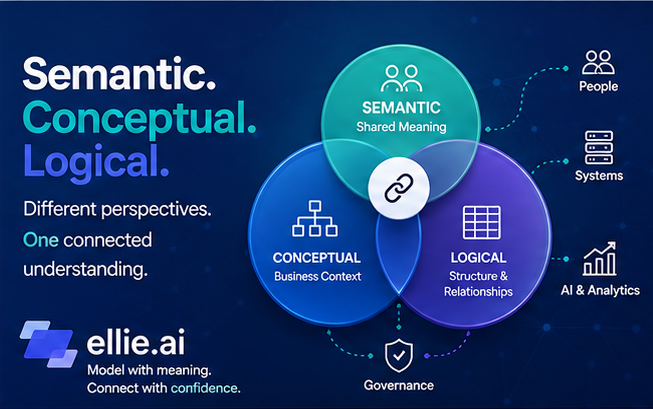
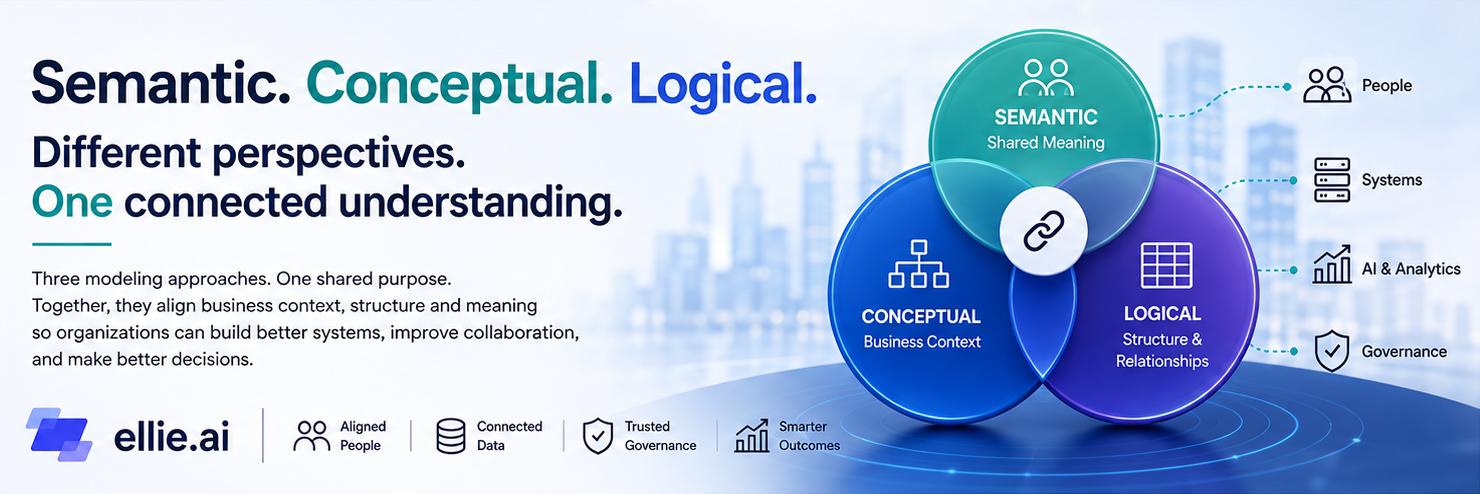
Organizations often treat semantic, conceptual, and logical modeling as competing approaches, but they are most valuable when used together. Each provides a different level of perspective while contributing to the same overall understanding of the business.
A conceptual model helps stakeholders understand the business at a high level. A logical model adds the structure needed to support implementation. A semantic model ensures the meaning behind the data remains clear and consistent across people, systems, and applications. Together, they provide a connected view of business information that supports governance, analytics, integration, and AI initiatives far more effectively than any single model on its own.
This connected perspective also improves data governance by keeping the business at the centre of the process. Connected models offer a shared understanding of business entities, relationships, and context that both business and technical stakeholders comprehend, rather than necessitating teams to manage technical assets in isolation. This allows for the easier establishment of governance practices that reflect how the organization actually works, and not how individual systems happen to store data.
When these perspectives are used together, organisations can move more confidently from business requirements to implementation. Models that support one another rather than stand alone benefit business stakeholders, architects, developers, and governance teams. The result is a stronger foundation for managing data as the business grows and changes.
Why modern data modeling Is about connection, not documentation
For many organizations, data modeling has been treated as a one-time project. A conceptual model is created during planning, a logical model is developed for implementation, and semantic definitions are documented somewhere else entirely. As the business evolves, those artifacts are updated independently, if they're updated at all. Over time, they become disconnected from one another and from the systems they were meant to describe.
Modern data modeling takes a different approach. Instead of treating models as static documentation, organizations are starting to think of them as connected assets that evolve alongside the business. When a business definition changes, that change should be reflected across conceptual, logical, and semantic models rather than requiring teams to update multiple disconnected documents by hand.
This is where connected modeling platforms really become useful. Organizations can keep models aligned as requirements change by bringing together business context, model structure, and common definitions within a single collaborative environment. This leads to greater consistency and collaboration between the business and technical teams and a stronger foundation for governance, analytics and AI initiatives.
Build a more connected data foundation with Ellie.ai
The most successful data strategies aren't built on a single modeling approach. They link business context, structure and meaning to create information that can be shared, governed and used with confidence. Ellie.ai integrates conceptual, logical and semantic modeling in a collaborative environment, allowing organizations to maintain alignment of business definitions, model structures and shared meaning as data and business needs continue to evolve.