
Every organization relies on shared business definitions. They determine who qualifies as a customer, when an account is considered active, which providers are eligible, how revenue is calculated, and countless other concepts that influence everyday operations. When those definitions vary across departments, the consequences extend beyond inconsistent terminology. They impact reporting, decision-making, governance, system integrations, and increasingly, artificial intelligence.
For years, unclear semantic definitions primarily created challenges for analytics and data governance. As organizations continue to invest in Agentic AI and automate more business processes, the consequences have become much broader. AI can only interpret information using the business meaning it has been given. If that meaning is inconsistent, incomplete, or disconnected, AI will confidently apply those same inconsistencies to its recommendations, workflows, and decisions.
This article dives into the business impact of unclear semantic definitions, why these challenges become more important as businesses adopt AI, and how a common semantic foundation can lead to more consistent, reliable business outcomes.
Business decisions depend on consistent definitions. When different departments interpret the same concept differently, they naturally reach different conclusions, even when they're working from the same underlying data.
Consider something as common as an "active customer." Marketing may define an active customer as someone who has made a purchase within the past 12 months. Finance may consider any customer with an open account to be active. Customer Success may rely on product usage instead. None of these definitions are wrong but they each enable different business objectives. In the absence of a shared understanding of when to apply each definition, organizations end up producing contradictory reports, rival KPIs and discordant operational decisions.
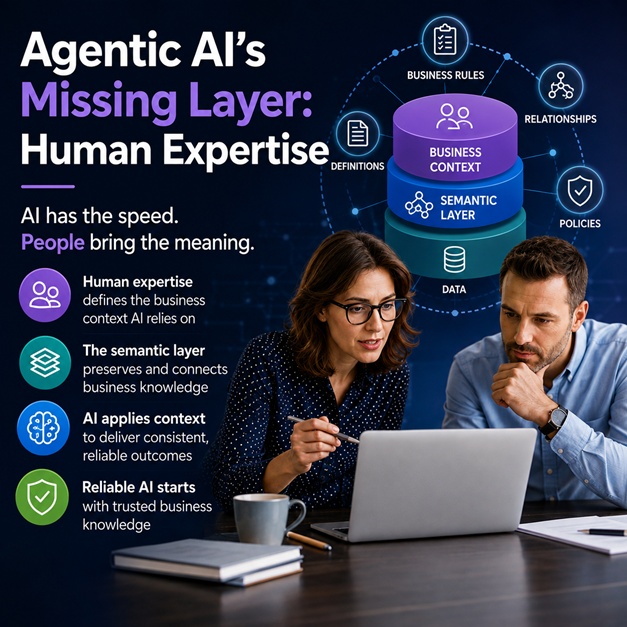
Traditional analytics required people to interpret reports before making decisions. Agentic AI participates in these decisions by recommending actions, coordinating workflows, interacting with enterprise systems, and supporting operational processes. Unlike experienced employees, AI doesn’t realize that different departments may have a different definition of the same business concept. It interprets the information in the semantic context it’s given.
If business definitions aren’t consistent, AI won’t be able to detect the discrepancy. Instead it will confidently produce recommendations that sound reasonable but subtly reflect incomplete or incorrect business meaning. Organizations are increasingly using AI as a tool to help with decision-making, and even small differences in semantics can impact customer interactions, operational workflows, compliance activities, and business outcomes at scale.
Organizations spend a lot of time and money on analytics to make better decisions, but the quality of those insights depends on the quality of the business definitions behind them. When different reports use different semantic definitions, leaders soon lose confidence in the numbers. The problem isn't necessarily poor data quality. More often, it's inconsistent business meaning. When organizations don’t share common semantic definitions, they create multiple versions of the truth, making analytics less trustworthy and more difficult to act on.
Before organizations can establish ownership, define policies, or improve data quality, they need agreement on what their core business concepts actually represent. When semantic definitions are unclear, governance efforts become fragmented. Different teams document the same concepts differently, ownership becomes difficult to establish, and governance initiatives struggle to scale consistently across the organization. Rather than governing technical assets in isolation, successful organizations govern business meaning. Clear semantic definitions provide the foundation that allows governance initiatives to remain aligned as the business evolves.
Organizations depend on information flowing between CRM platforms, ERP systems, financial applications, operational systems, and cloud services. While technical integration connects the data, it doesn't automatically align the meaning behind that data. The same business entity can appear differently in different systems. Each application was built for a different purpose, so customer status, product categories, account ownership or eligibility criteria can differ. That means that if there are no shared semantic definitions , every new integration adds a chance of inconsistent interpretation .
Many organizations view ambiguous semantic definitions as minor documentation issues, but that’s not the case; they introduce enterprise-wide business risks. A single inconsistent definition can influence dashboards, reporting, automation, governance initiatives, AI recommendations, compliance activities, and executive decision-making. As information moves between systems and departments, those inconsistencies become embedded throughout the organization.
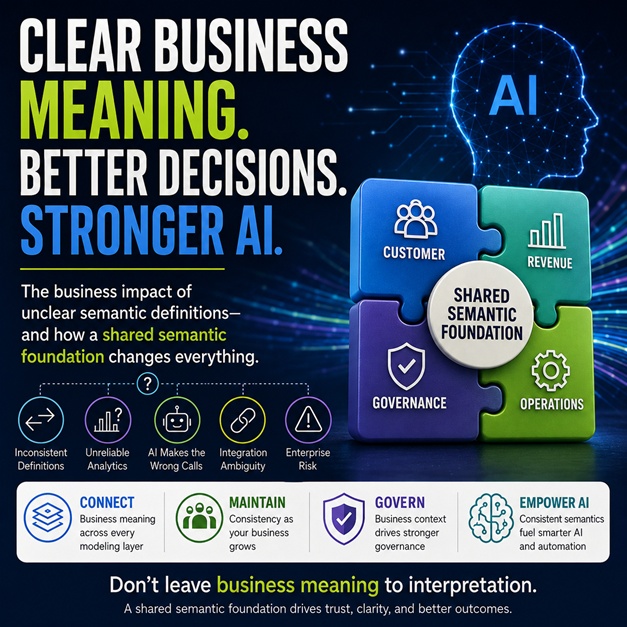
Clear semantic definitions are only valuable if they remain consistent across the organization. As new systems, projects, and business domains are introduced, maintaining that consistency becomes increasingly difficult. That's why organizations need more than a business glossary. They need a shared semantic foundation that keeps business definitions connected to the models, relationships, and governance processes that depend on them. Here’s how to get started:
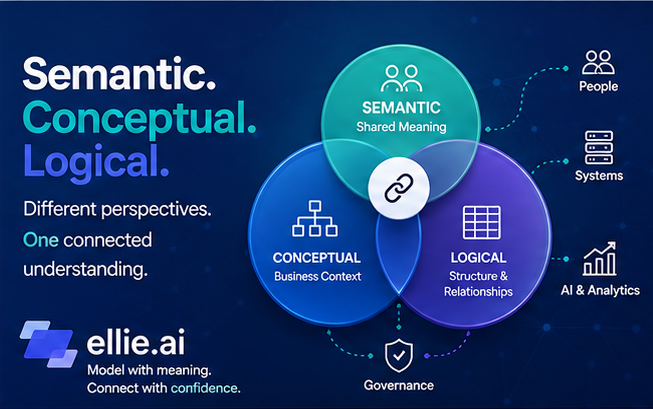
Ellie.ai allows organizations to build a common semantic ground by connecting business definitions to conceptual, logical and physical models in a single collaborative environment. This enables organizations to have a connected view of how business concepts, relationships and technical implementations fit together, rather than having to manage business glossaries, data models and governance artifacts as separate pieces.
A connected approach helps maintain semantic consistency over time. Modern modelling platforms like Ellie.ai allow teams to link glossary terms to logical entities and physical models directly, classify definitions by business domain using sub-glossaries and, instead of repeatedly re-defining business entities, re-use them across projects. This helps to maintain business meaning and reduce ambiguity across analytics, governance, integration, and AI initiatives.
Modern modelling platforms like Ellie.ai strengthens governance by focusing on business entities and their relationships rather than technical metadata alone. Business and technical stakeholders can collaborate around concepts they both understand, visually map business relationships, and integrate with enterprise data catalogs such as Microsoft Purview and Collibra to keep governance initiatives aligned with business context.
Ellie.ai helps create a universal semantic layer that gives AI access to consistent business context, helping ensure recommendations, automation, and analytics are based on shared business meaning rather than fragmented definitions. AI-assisted modeling, reverse engineering from more than 170 source systems, and collaborative conceptual modeling further accelerate the creation and maintenance of that shared understanding.
Every report, workflow, AI recommendation, and business decision depends on a shared understanding of what the data represents. When that meaning is consistent, organizations can move faster with greater confidence. Ellie.ai helps organizations create that shared understanding by keeping business definitions connected throughout the modeling lifecycle, providing a stronger foundation for governance, analytics, and AI.