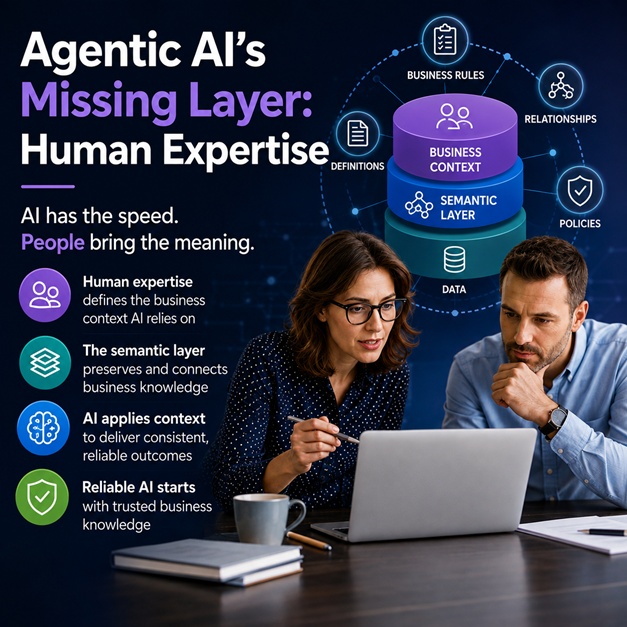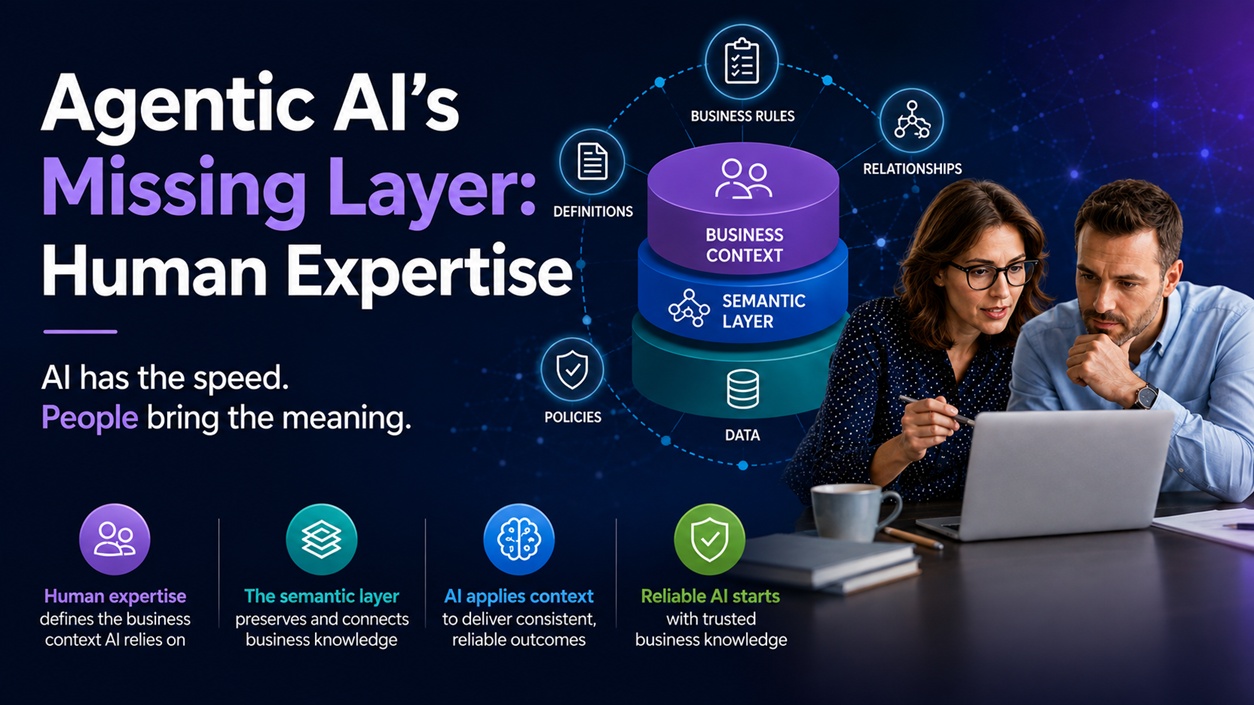

Agentic AI can model, automate workflows and analyze information at a scale that was not possible before. What it can't do is determine whether those outputs reflect how the business actually operates. That understanding comes from people. Business experts define the meaning behind the data, resolve ambiguity, and apply the judgment that doesn't exist in source systems or documentation. The semantic layer preserves that expertise, turning individual knowledge into shared business context that people and AI can use consistently.
As organizations expand their use of Agentic AI, capturing and maintaining that business context becomes just as important as the technology itself. In this article, we'll learn why human expertise is important, how the semantic layer preserves it, and why both are critical to building reliable AI.
Every organization depends on concepts that seem straightforward until someone asks for a definition. What qualifies as an active customer? When does a lead become an opportunity? Which provider is considered eligible? The answer is usually different depending on which team you ask. Those differences aren't necessarily a problem, but they need to be defined and understood.
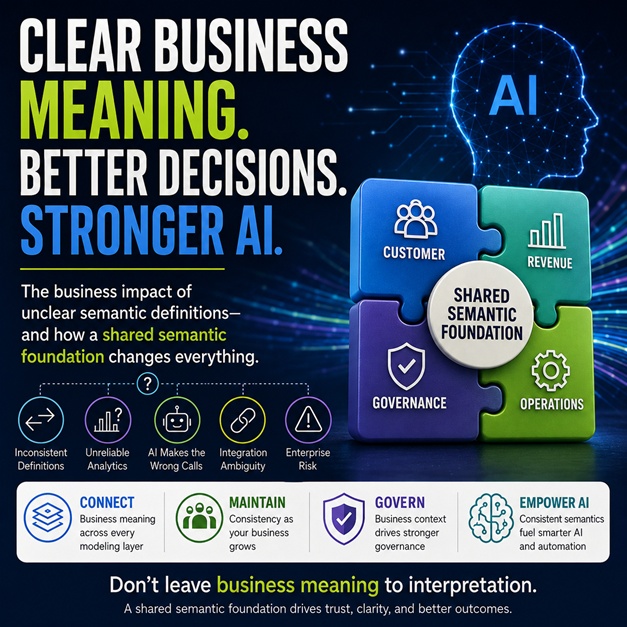
Organizations often need to support multiple valid definitions across business domains while maintaining clear relationships between them. The same is true for Agentic AI. AI applies the business context it has been given. If definitions, relationships, and business rules haven't been clearly captured, AI has no way to determine which interpretation is correct for the scenario at hand.
Organizations don't lose knowledge because they lack data. They lose it because critical business understanding lives in conversations, spreadsheets, documentation, or the experience of a handful of team members.
The semantic layer makes this information accessible by capturing how the organization understands its business, from definitions and business rules to relationships, ownership, and policies. Rather than requiring teammates to explain how the business works, organizations can create a shared foundation that people, systems, and AI can reference and leverage when needed.
AI is good at spotting patterns in the data it has access to, but not at understanding the purpose or logic behind it. It can’t explain why a process exists, why a decision was made, or whether an exception is a true representation of how the business really operates. The business priorities, past decisions and organizational context all come from the people who know the business.
AI can help with:
People are responsible for:
AI can reduce the time spent on repetitive modelling tasks, but people provide the business knowledge and judgment needed to produce models that are accurate, practical, and aligned with the way the organization works.
Agentic AI applies business knowledge across decisions, workflows, and interactions. When that knowledge is accurate, it produces more consistent outcomes. When it's incomplete or ambiguous, it can make the same mistakes over and over again.
This is why a human touch is still important. Subject matter experts define the business context AI relies on, from business definitions and policies to relationships and exceptions. Improving that shared understanding doesn't just answer a single question. It improves every decision that depends on it.
Before expanding the use of Agentic AI, organizations should ask a few key questions:
If the answer to any of these questions is "no" or "not consistently," the challenge is unlikely to be the AI itself. More often, it's the business context supporting it.
Building reliable Agentic AI requires more than documenting business knowledge. Organizations also need to keep that knowledge connected as it evolves.
A solid foundation starts with 4 key practices:
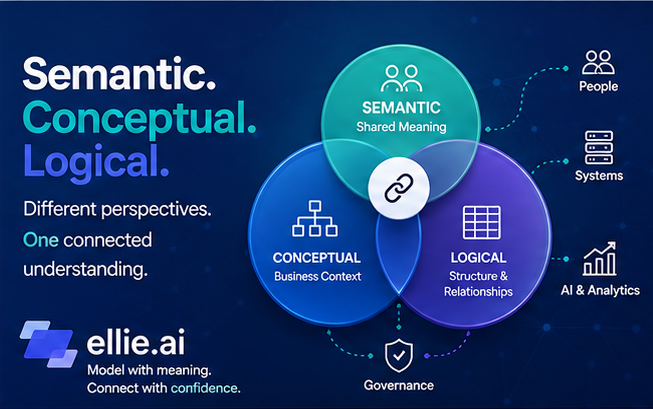
Modern modeling platforms like Ellie.ai help teams enforce these practices by linking semantic definitions across conceptual, logical and physical models in a collaborative environment. Integrations with Microsoft Purview and Collibra help extend that common business context across the wider data ecosystem, while AI-assisted modeling and reverse engineering speed up the creation and maintenance of connected models.
Agentic AI is only as good as the business context it’s built in. Organizations that capture human expertise, maintain consistent business definitions, and connect knowledge across the modeling lifecycle are more likely to produce reliable, repeatable results.
Ellie.ai helps organizations build that foundation by bringing business experts, semantic definitions, and connected models together in a collaborative environment. This common understanding of the business leads to more effective modeling, better governance and more trustworthy AI.