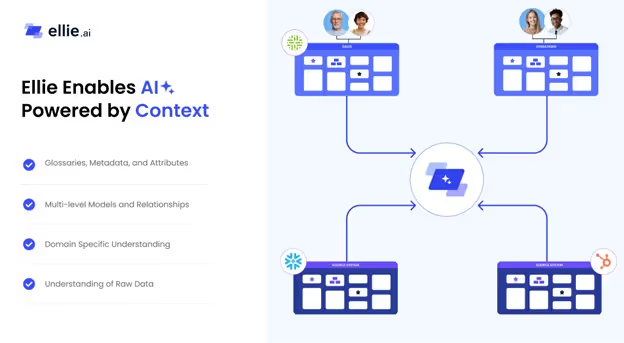
Ellie AI helps you create semantic context for your agentic AI efforts
Ellie allows your business and data teams to collaborate and build semantic models that provide context for agentic AI efforts. Without clear context, AI agents will struggle to provide accurate answers for your data consumers.
Imagine asking a question "show me profitability in last quarter for active customers." - this query, while looking simple and straight forward, lacks context for quarter (fiscal or calendar), profit margin (net or gross) and what constitutes active customer. The agenti will confidently answer but it might be completely inaccurate. Read more about agentic AI context here
Until now, using AI for data modeling often meant a disconnected workflow: chatting with a bot in one window, and manually building models in another.
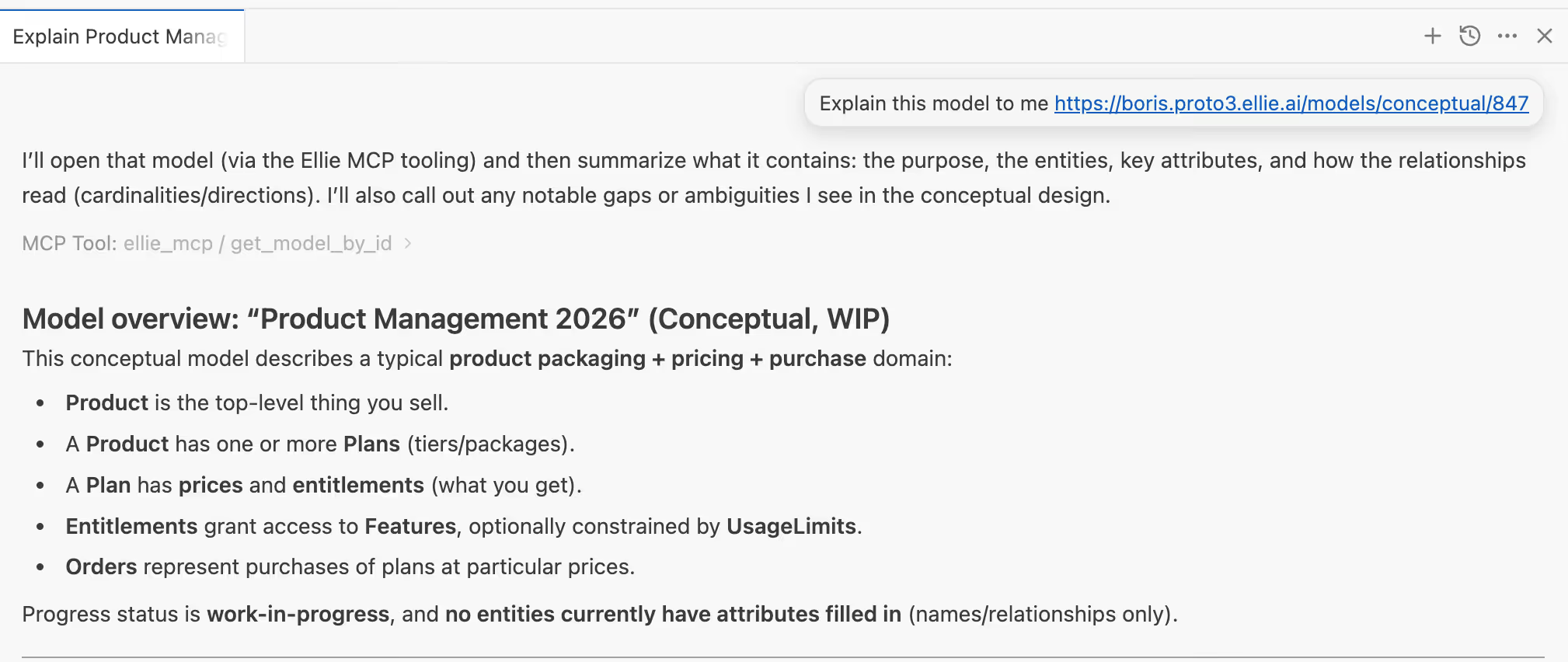
The Ellie MCP Server changes this by providing AI assistants—such as Cursor, Windsurf, or Claude Desktop—with the ability to interact directly with Ellie’s platform. By utilizing a standardized set of tools via the Model Context Protocol (MCP), it allows LLMs to perform real operations on your data models, not just talk about them.
Read more about the capabilities here
Ellie allows you to create conceptual models from text such as an explanation of a business model. You just need to paste business requirements (plain text or documents) and AI extracts candidate conceptual entities and relationships and proposes those to the user. The user then accepts or rejects the suggestions after which Ellie generates the first conceptual model.
You can continue to chat with Ellie to enhance the model or have AI explain the model to you in language that's understandable to all stake holders.
Ask questions or give commands directly inside the conceptual‑modeling canvas:
The copilot analyses the canvas graph in real time and can create/edit entities & relationships for you. You can easily enhance your model by asking AI to offer recommendations on additional entities, explain current model or propose and add relationships to the canvas.
It's a rare occurrence that data modeling starts from empty canvas with no dependencies to existing systems. At Ellie, we know what it takes to reverse engineer legacy and even modern systems. Various ERP systems have tens of thousands to hundred thousand and more tables and bringing all those to an ERD or physical model canvas is usually impractical.
To solve this challenge we have developed Ellie Source Navigator capability that leverages connectors to over 170 systems and databases and leverages AI to create synthetic metadata for better understanding.
Reverse engineer, Document and Find source tables within your Ellie environment.
AI Source Navigator lets teams:
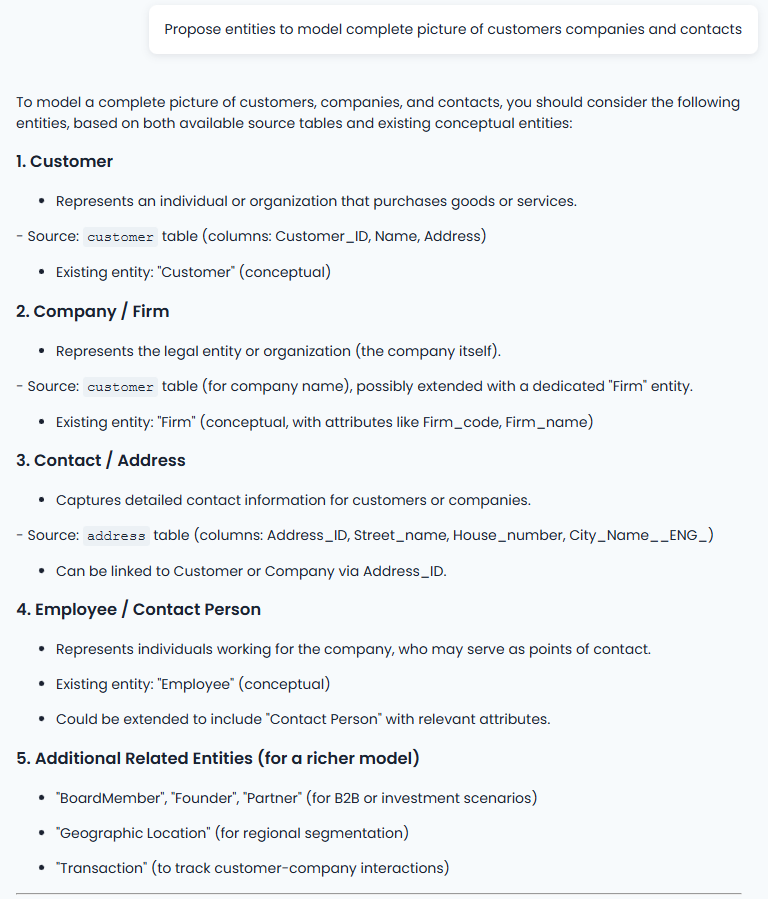
Chat‑based discovery - provide a task to the AI and it will find the most relevant source tables for your analysis. Example prompts:
Lumi by default will work with OpenAI model and provide reasoning for the answer as well as potential expansion to query in context. The context covers existing models as well as any table that is available in the source navigator and leverage both synthetic as well as original metadata.
Lumi will not store any customer data nor will it use metadata or actual table contents for training purposes.
Lumi chat can also be used to perform other tasks such as compare models, which is useful when reverse engineering production physical models and comparing them to original Ellie models to identify production changes that didn't go through the modeling workflow.
To increase security and relevance the user organization can easily change the large language model that Ellie uses from the default OpenAI setting to any of the major models such as Anthropic Claude, AWS Bedrock, Mistral, Azure AI or proprietary OpenAI models.