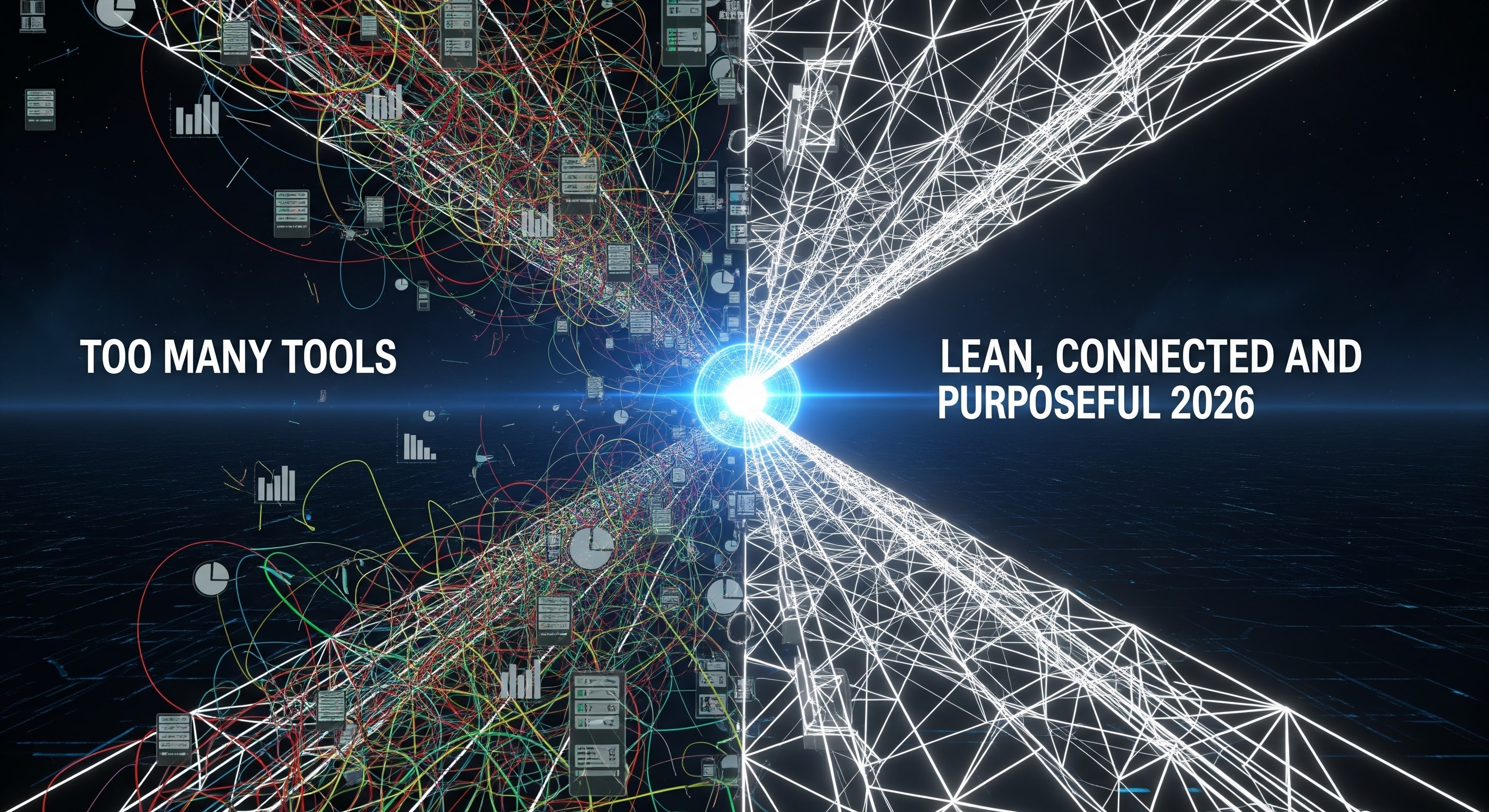

The modern data stack was supposed to make things easier. Instead, most organizations are weighed down by underused tools, platforms that teams never fully adopted, and dashboards with conflicting information. The “tool explosion” of the 2020s solved some problems but created a bigger one: complexity. Too many platforms, too many definitions, and not enough alignment.
As 2026 approaches, the winners won’t be the companies with the most tools, they’ll be the ones with the cleanest stacks.Success won’t come from adding more, it will come from making hard choices about what to keep, what to kill, and what to combine.
The Current State: Too Many Tools, Too Little Alignment
The past five years have been a golden age of data tooling. Venture-backed innovation created a product for every conceivable niche including ingestion, transformation, catalogs, observability, lineage, visualization, governance. Many of these tools solved real problems, but most organizations didn’t consolidate — they layered new tools on top of old ones.
The result is a stack where:
What was meant to drive efficiency has become a burden. Teams spend more time managing the stack than using it to deliver insights.
What to Keep
Some parts of the stack remain non-negotiable. These are the tools that provide the backbone of data value creation.
Platforms like Snowflake, Databricks, BigQuery, and Redshift remain at the center of the data stack. They provide the scale, reliability, and flexibility required to store and process enterprise data at volume. In 2026, the warehouse or lakehouse is not just infrastructure, it’s the foundation that every other tool or product depends on.
The rise of decentralized data product teams makes a connective modeling environment essential. Ellie.ai provides that layer by aligning business and technical stakeholders around consistent definitions, models, and metadata. Without this semantic backbone, organizations risk metric drift, duplication, and misalignment across domains. With it, they gain clarity and coherence, regardless of how distributed their teams are.
Accuracy and trust remain non-negotiable. Tools that continuously monitor data quality, provide lineage, and enforce governance ensure that stakeholders can rely on what they see. These platforms also keep organizations compliant, making them both a business and legal necessity.
While the ELT explosion of the early 2020s led to tool sprawl, organizations still need one robust integration layer. A streamlined pipeline platform provides consistency and reduces engineering overhead. The key is not having many ETL tools, but the right one.
A business can’t run without clear reporting. While multiple BI platforms breed confusion, a single primary analytics environment remains a must-have. Whether that’s Looker, Tableau, or Power BI, the chosen platform should act as the single pane of glass through which the organization interprets performance.
Beyond pipelines and platforms, teams need a shared space to document context, give feedback, and align on models. Without this, decisions happen in silos, and critical insights are lost. Ellie.ai doubles as this environment, helping teams move faster while staying consistent.
As stacks simplify, access control can’t be an afterthought. Role-based permissions, encryption, and zero-trust access models remain essential. These tools may not be flashy, but without them, every other layer of the stack is at risk.
What to Kill
Here’s the uncomfortable truth: not every tool deserves a spot in your stack. The past five years of rapid tooling growth left most organizations with layers of overlap, redundancy, and half-adopted platforms. Some tools were never mission-critical; others have since been outpaced by stronger competitors.
Having two or three ingestion and transformation platforms is almost always unnecessary. It leads to duplicate pipelines, extra maintenance, and inconsistent data quality checks. One tool, standardized across the organization, is enough. Everything else adds noise.
Multiple BI environments create a false sense of choice but inevitably lead to conflicting dashboards. When the same question yields three different answers depending on the tool, trust is lost. Secondary or underused platforms should be eliminated in favor of a single, well-governed source of truth.
The past five years introduced countless tools promising to solve different aspects of the data lifecycle including lineage visualizers, lightweight glossaries, custom metrics trackers. While helpful in isolation, most add more friction than value. If a tool isn’t core to daily workflows or directly tied to outcomes, it isn't beneficial to keep in your tech stack.
Many companies adopted multiple metadata and documentation solutions in parallel. The result is scattered context and frustrated users. In 2026, these belong in one system, not five.
Older platforms, often maintained “because we’ve always used them,” drag the stack down. Whether it’s a legacy reporting tool or an outdated ETL system, nostalgia isn’t a strategy. If a system can’t integrate seamlessly with the modern stack, it’s a liability.
Business units often spin up their own SaaS reporting or analytics tools without central oversight. These “shadow” tools fragment data governance and create inconsistent definitions. In 2026, they either need to be absorbed into the official stack or eliminated.
Homegrown jobs and Python scripts may have solved urgent problems in the past, but they rarely scale. They’re fragile, poorly documented, and increase dependency on individuals. As the stack matures, these must give way to standardized, automated processes.
What to Combine
If 2025 was the era of “more,” then 2026 is the era of consolidation. Instead of ten-point solutions, the future stack relies on integrated platforms and connective layers.
Ellie.ai replaces scattered glossaries, static documentation, and ad-hoc models with a single, collaborative environment. It acts as the semantic backbone of the stack, ensuring that data products across domains are aligned, discoverable, and trustworthy. By centralizing modeling and metadata in a living system, Ellie.ai reduces redundancy and prevents drift before it happens.
Additional opportunities to combine include:
2026 Trends: Where the Stack Is Headed
Beyond the choices of what to keep, kill, or combine, several broader trends are shaping how the data stack will evolve in 2026 and beyond.
Every layer of the stack is being infused with AI copilots. From anomaly detection in observability platforms to automated glossary building and model generation, AI is reducing the manual burden of governance and alignment. The best tools won’t bolt AI on as a feature, they’ll be rebuilt around it. Ellie.ai already reflects this shift, using AI to accelerate modeling, surface semantic conflicts, and guide alignment across teams.
The era of 50+ point solutions is ending. Vendors are either expanding their offerings into broader suites or positioning themselves as indispensable integrations within an ecosystem. Buyers will gravitate toward fewer, stronger partners rather than spreading budget across dozens of niche players. Ellie.ai is designed to thrive in this environment: it doesn’t replace everything, but it plugs seamlessly into the core stack and becomes the connective tissue between business and technical tools.
Most organizations will orient their stacks around a primary gravity well and build out from there. Smaller tools that don’t integrate deeply with these ecosystems will struggle to survive. Ellie’s integrations with leading warehouses and lakehouses make it an ecosystem-friendly layer, ensuring consistency without disrupting core workflows.
Categories once considered separate are collapsing. The market is moving from fragmentation toward integrated experiences. Ellie embodies this convergence by replacing scattered glossaries, documentation, and modeling tools with a single, collaborative environment.
Regulations around privacy, AI usage, and cross-border data are intensifying. Governance will no longer be an overlay; it will be embedded directly into tools. Ellie.ai operationalizes this principle by baking glossary controls, ownership metadata, and versioned models into the everyday workflows of data teams so compliance and governance happen by default.
As data mesh and product-oriented thinking become mainstream, organizations are realizing that the missing link isn’t more pipelines or dashboards, its semantic consistency. Ellie.ai provides a collaborative fabric that allows decentralized teams to move fast while still speaking the same language.
The Vision for 2026
The future of the stack isn’t about chasing every new category — it’s about focus. The winners will be organizations that simplify, integrate, and align. Instead of a fragile ecosystem stitched together with connectors, the stack becomes lean, connected, and purposeful.
Ellie.ai sits at the center of this vision. Not as another point solution on top of the pile, but as the connective tissue that ensures data products are consistent, and usable. By combining collaboration with governance, Ellie.ai helps organizations get more from the tools they keep and less from the tools they cut.
Hard Truths, Real Value
Cutting tools is uncomfortable. It means questioning sunk costs and saying no to vendors who’ve promised the world, but the truth is unavoidable. Every duplicate tool dilutes trust. 2026 is the year to make the hard calls. Keep what’s essential, kill what’s redundant, and combine where possible. The future of the stack isn’t about size — it’s about clarity. With Ellie.ai, organizations don’t have to choose between speed and trust. You can have both.