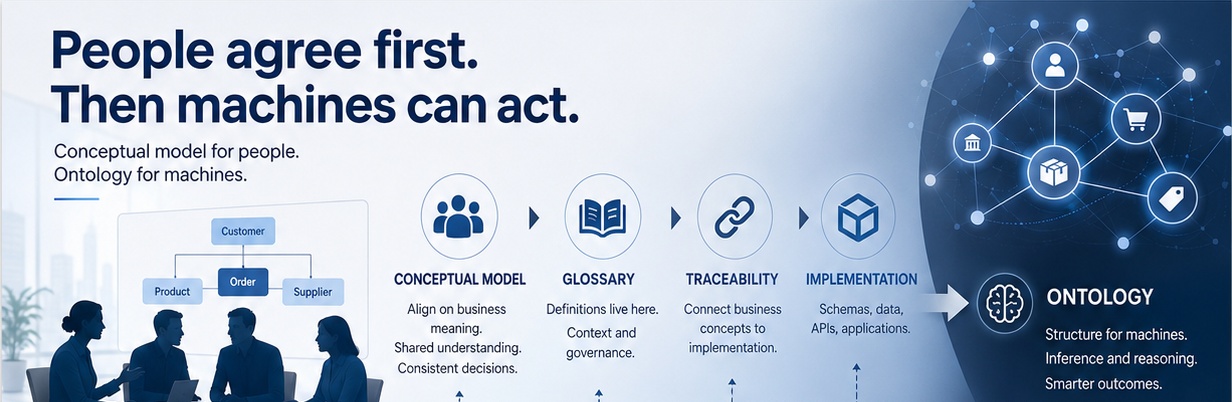

Semantic layers, knowledge graphs, ontologies, conceptual models. These terms get used interchangeably in vendor decks and conference talks, but they solve different problems for different audiences. The short version: a conceptual model is built for people to agree on what the business means. An ontology is built so software can act on that meaning. Both create consistency. Both support governance and analytics work. But conflating them is how AI and knowledge graph projects quietly stall.
Before you can govern data, integrate systems, or train a model on your business, you need people to agree on what your terms mean. That's not a technology problem, and it doesn't get solved by buying an ontology tool.
Take a retailer with Customer, Product, Order, and Supplier. A conceptual model maps how these relate: customers place orders, orders contain products, suppliers provide products. Nothing about tables or schemas here, just the shape of the business.
The reason this matters: sales, finance, and support routinely define "customer" differently, and nobody notices until a report doesn't reconcile. A CRM might count anyone with an active account. Finance counts anyone who's generated revenue. Support counts anyone who's filed a ticket. None of these definitions is wrong. They're just incompatible the moment two departments try to share a number.
Agreeing on what "customer" means once isn't enough, because that agreement has to survive employee turnover, org changes, and new systems. Without a central place to keep it, definitions end up scattered across old Slack threads, a wiki nobody updates, and whatever the last person who left explained verbally.
A business glossary is that central place. It doesn't force sales and finance into one definition of customer, it lets both definitions exist with the context for why they differ. That's the difference between a glossary and just picking a winner.
An ontology takes the same kind of business concepts and adds formal structure a machine can act on: categories, hierarchies, constraints, inference rules. A conceptual model says Customer is an entity. An ontology can say Customer is a subtype of Person, Premium Customer is a subtype of Customer, and a system can infer that a Premium Customer is entitled to whatever a Customer is entitled to, plus more.
That inference capability is the whole reason ontologies matter for knowledge graphs, semantic search, and AI applications. It's not a fancier documentation format, it's a structure software can reason over.
Most ontology or AI initiatives that stall aren't stalled by technical complexity. They're stalled because the business never agreed on the concepts being formalized. If sales and finance never resolved what "customer" means, building an ontology on top of that doesn't fix the disagreement, it encodes it into infrastructure that's now harder to change than a spreadsheet was.
That's the actual argument for sequencing: conceptual model first, glossary to maintain it, ontology to formalize it for machines. Not because it's a best practice checklist, but because building the formal layer on unresolved business meaning just makes the disagreement more expensive to fix later.
Ellie.ai is built for semantic modeling: getting business concepts and definitions agreed on before anyone starts building the ontological layer on top. That means collaborative definition management with the people who actually own the terms, a company-wide glossary, traceability from business concepts down to implementation, and conceptual modeling that stays business-focused rather than jumping straight to schema. Of course ellie.ai conceptual and logical models can be easily turned into OWL or other ontology formats that let's you continue work based on the shared understanding of the business entities and relationships.
The pitch isn't "buy more semantic tooling." It's "don't build the machine-readable layer on a business layer nobody's agreed on yet.".