
Enterprise data teams spend a significant amount of time debating architecture methodologies. Should the organization adopt Data Vault? Move toward dimensional modeling? Implement a medallion architecture? Follow Kimball, Inmon, or a hybrid approach?
These are important decisions, but many organizations focus on them too early. Before selecting a methodology, teams need alignment around business entities, relationships, definitions, ownership, and governance requirements. Without that shared understanding, even well-designed architectures can create inconsistent reporting, duplicated logic, and governance challenges.
In this article, we’ll explore why conceptual and semantic modeling should happen before organizations commit to methodologies like Data Vault, Kimball, dimensional modeling, or medallion architectures and why strong data products are built on shared business understanding rather than a single implementation framework.
Why Teams Become Focused on Methodologies
Methodology discussions dominate enterprise architecture conversations because organizations are looking for structure as systems become more complex.
Teams often debate:
These conversations are usually influenced by modernization initiatives, cloud migrations, vendor ecosystems, and changing reporting requirements. Methodologies also feel easier to solve than organizational alignment. It’s often easier to debate implementation patterns than to resolve inconsistent definitions, ownership structures, governance processes, and business terminology across teams.However, methodology alone doesn’t solve alignment problems.
What These Methodologies Actually Solve
Each architecture methodology provides value in different areas of the enterprise data lifecycle.
Data Vault is designed to support scalability, auditability, and historical tracking across evolving enterprise systems. It’s often used in environments where lineage and long-term traceability are important.
Dimensional modeling prioritizes analytics usability and reporting performance. It helps structure data in ways that are easier for business intelligence and reporting teams to consume.
Inmon-style architectures focus on centralized enterprise integration and consistency across the organization.
Medallion architectures help teams organize staged data refinement across modern cloud and lakehouse environments. These frameworks improve structure around ingestion, transformation, and downstream consumption.
All of these methodologies provide value. However, none of them solve semantic alignment or shared business understanding.
Why Conceptual Modeling Should Happen First
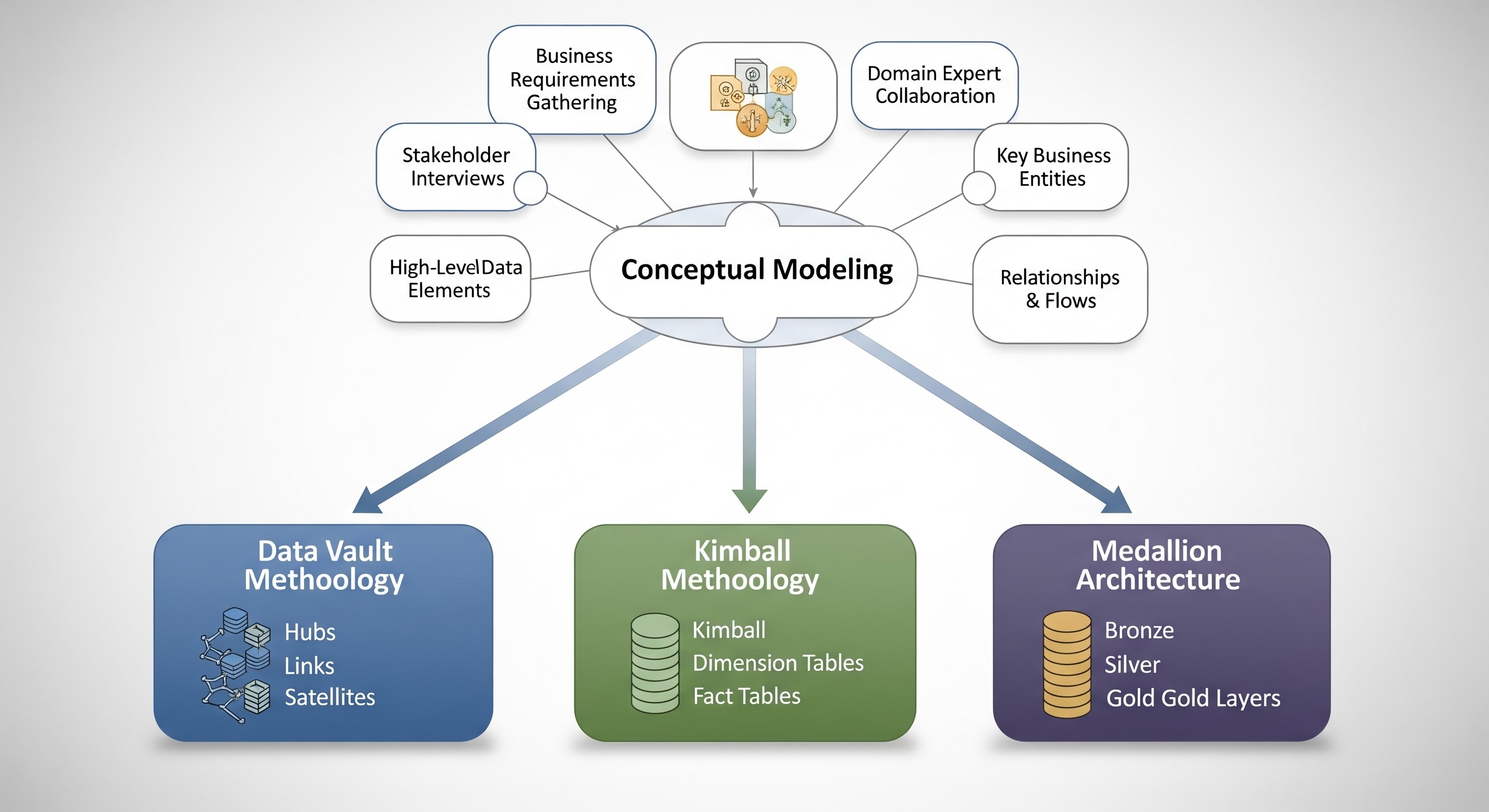
Before organizations decide how data should be structured technically, they first need to align on what the business is actually describing. Conceptual modeling helps organizations define:
This creates a shared understanding that supports governance, reporting, architecture, analytics, and operational alignment across the organization. Without conceptual alignment, organizations often implement technically sound architectures that still produce inconsistent metrics, duplicated logic, governance confusion, and reporting discrepancies. Methodologies structure data, while conceptual modeling structures understanding. This distinction becomes increasingly important as enterprise environments become more complex.
The Risks of Choosing Architecture Before Alignment
Organizations that prioritize implementation methodology before conceptual alignment often create long-term governance and reporting problems.
Different domains may define the same business concepts differently across systems and reporting environments. Over time, this creates inconsistent reporting and duplicated transformation logic.
Teams often need to redesign models later when governance initiatives expose semantic inconsistencies that were never resolved upfront.
Without shared conceptual understanding, governance teams spend significant time reconciling definitions and resolving inconsistencies after implementation rather than preventing them earlier in the process.
Organizations can become tightly coupled to implementation frameworks that no longer fit evolving business requirements or modernization initiatives.
When reports, metrics, and definitions conflict across systems, confidence in enterprise data begins to erode.
These problems are rarely caused by the methodology itself. They are usually caused by the absence of shared understanding before implementation begins.
Strong Data Products Are Methodology Agnostic
Strong data products are built on shared business understanding, semantic consistency, and governance alignment rather than a single modeling methodology. As enterprise architectures evolve, organizations may shift between Data Vault and dimensional modeling, warehouses and lakehouses, or centralized and decentralized environments depending on changing business and technical requirements.
This is why conceptual modeling matters. Organizations that establish shared business entities, relationships, and governance foundations early can adapt more easily as architectures, tools, and implementation strategies evolve over time.
Conceptual Modeling Improves Long-Term Governance
Enterprise systems are constantly evolving as organizations modernize infrastructure, migrate platforms, adopt AI initiatives, and restructure data environments. Conceptual modeling helps maintain consistency throughout these changes by creating a stable foundation for shared understanding across teams and systems.
This helps organizations maintain consistent business definitions, reduce semantic fragmentation, improve governance alignment, support cross-functional collaboration, preserve organizational knowledge, and adapt more effectively during modernization initiatives.
As enterprise ecosystems become more distributed and interconnected, this shared understanding becomes increasingly important for governance, reporting consistency, and long-term operational alignment.
Why Enterprises Are Revisiting Conceptual and Semantic Modeling
Many organizations are revisiting conceptual and semantic modeling because technical modernization alone hasn’t solved alignment challenges. Despite investments in cloud platforms, data lakes, AI initiatives, and modern analytics tooling, organizations still struggle with inconsistent definitions, fragmented governance workflows, duplicated metrics, and disconnected business and technical teams.
As a result, more enterprises are investing in:
This reflects a broader shift in enterprise data strategy. Organizations are recognizing that governance maturity depends heavily on whether teams operate from a shared context layer and maintain the same understanding of business concepts, relationships, ownership, and definitions across systems.
Build More Flexible Data Foundations With Ellie.ai
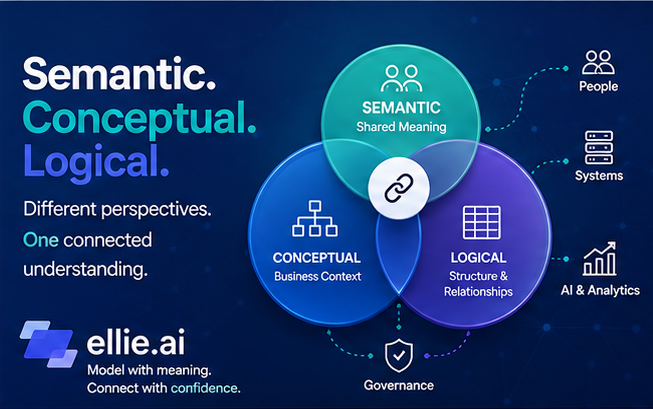
Ellie.ai helps enterprises connect business context with technical architecture through collaborative, governance-aware modeling. We support conceptual, logical, and physical modeling within the same environment, allowing your team to move from business understanding to implementation while maintaining alignment across stakeholders.
Ellie.ai also supports methodologies like Data Vault, dimensional modeling, star schemas, and lakehouse architectures, giving organizations flexibility to evolve implementation strategies over time without losing consistency around core business concepts. Features like integrated business glossaries, model versioning, real-time collaboration, and AI-assisted modeling help governance teams, architects, analysts, and business stakeholders work more effectively across the enterprise. Get started with a free trial today.