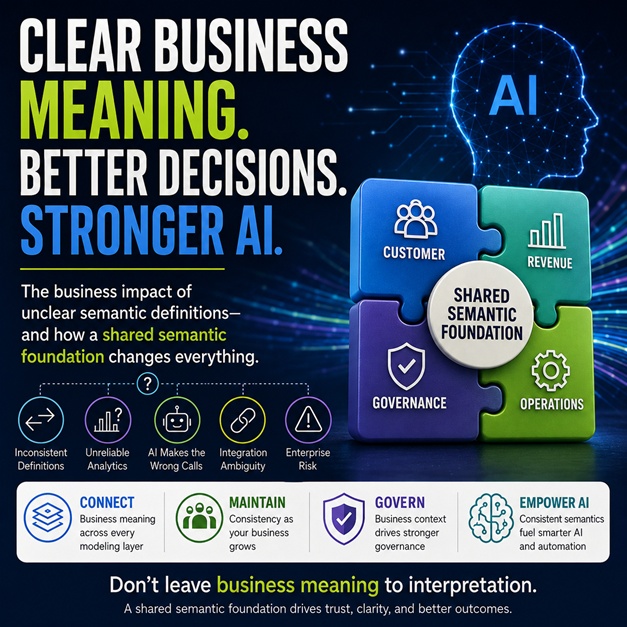
Data teams today move quickly. They integrate new tools, build new data assets, and explore AI driven capabilities at a rapid pace. Yet the same core issue keeps resurfacing: many of these systems are created without a shared understanding of what the data actually means. When meaning is missing, teams spend more time correcting issues than developing new capabilities. When modeling becomes the first stop in the data journey, humans define the semantics up front so AI and automation can carry that understanding forward at scale.
The most effective way to break this cycle is to rethink where the data journey begins. Before analytics, before orchestration, and before AI, organizations need clear semantics. This article explores why modeling must be the starting point of modern data work, how it strengthens the entire data lifecycle, and a practical way to start with the model so you can move forward instead of constantly cleaning up the past.
Modeling as the Foundation of Meaning
Many organizations still treat modeling as something they can address later, when in reality, modeling is the only practice that defines what the data represents, how concepts connect, and how information should be interpreted across the business. It creates the shared language teams rely on to make accurate decisions.
Without that shared meaning, teams interpret fields differently, apply their own rules, and define terms in ways that conflict with one another. Over time, these inconsistencies spread through the stack. Modeling isn’t extra work; it’s the structural foundation of the data ecosystem. A clear model gives everyone a consistent understanding of the business, ensuring that whatever they build, they are building on solid ground.
Why Your Data Journey Should Start with Modeling
When teams begin building before they establish meaning, small misunderstandings quietly accumulate until they become significant problems. Metrics drift across teams, business rules end up buried inside code, and data products that initially seem helpful start to lose credibility because no one can fully explain what’s driving them.
This dynamic creates a cycle many organizations know well. Each new request raises fresh questions about past decisions, teams spend hours unraveling logic instead of designing better solutions, and shadow spreadsheets and unofficial dashboards emerge. Starting with modeling stops this cycle before it begins. A shared model grounds early conversations in a common understanding of the key concepts, how they relate, and which rules matter.
How to Start with the Model: A Practical Approach
Being told to model first may sound abstract, but it does not need to be complicated. Here is a simple way to get started.
This process can start small. Even a lightweight conceptual model expressed through a handful of definitions and diagrams can dramatically reduce confusion downstream.
How Ellie.ai fits into this approach
Ellie.ai supports a model-first workflow by providing teams with a centralized place to capture conceptual meaning, refine it collaboratively, and carry it forward into more technical designs. Humans define the semantics, and Ellie.ai helps extend that understanding through the rest of the data lifecycle so it remains consistent as systems grow.
How Clear Semantics Unlock Automation, Governance, and AI
Once you have a clear model, many other ambitions become much more realistic. Automation is easier to design because business rules and relationships are explicit. Governance becomes more than policy documents because it can tie directly to entities and attributes in the model, and AI initiatives are less risky because training data, prompts, and outputs can be aligned with well-defined concepts.
Teams no longer need to guess what a field means when they write a transformation or build a feature because they can trace it back to a shared definition and a set of relationships in the model. This reduces the chance that automation acts on the wrong interpretation or that AI systems reinforce inaccurate assumptions. Semantics aren’t a nice to have. They’re the connective tissue that holds modern data and AI systems together. Modeling is the place where those semantics are made explicit.
Modeling as a Strategic Capability
Modeling used to be treated as a slow, specialist activity that produced diagrams nobody read. In modern data teams, it plays a very different role. A strong modeling practice empowers product managers, analysts, engineers, and domain experts to all look at the same model and talk about how things work today and how they should work in the future. Decisions about architecture, AI use cases, data products, and governance become more grounded because they are anchored in a shared understanding of the domain.
Building on Models Instead of Cleaning Up the Past
The advantage of starting with the model is cumulative. A clear semantic foundation can be reused and extended across new projects, creating a consistent backbone for analytics, operations, and AI. Teams stop reinventing definitions and rebuilding context every time they begin something new.
When modeling comes first, organizations gain meaningful long-term benefits including:
In contrast, organizations that skip modeling often end up in a constant cycle of cleanup, with every new system adding more divergence and confusion. Those that begin with meaning move faster because they are working from shared definitions rather than correcting past misunderstandings.
Make Modelling the First Step in Your Data Workflow
Modeling belongs at the start of the data journey because nothing else works reliably without shared meaning. Analytics, governance, automation, and AI all depend on clear semantics, and those semantics only exist when teams define them intentionally.
Starting with the model captures that meaning early. Humans establish the concepts and rules, and AI can then scale that understanding across the stack. Modeling is central, not optional, and it is the step that unlocks real value by preventing rework and grounding every decision in the same semantic foundation.
When you start building on your models, you can stop fixing yesterday’s problems and start designing for what comes next. If you want a practical way to put modeling first, explore how Ellie.ai helps teams define meaning and carry it through every layer of the data lifecycle.