
Financial institutions operate in one of the most complex and highly regulated data environments in the world. As regulatory expectations increase and business change accelerates, Chief Data Officers are under pressure to deliver trusted, explainable, and scalable data foundations without slowing the organization down. Full-stack data modeling provides a practical way to align regulatory intent, business concepts, and production data giving financial institutions the control they need and the agility they demand.

The Reality of Data in Financial Services

Most banks, insurers, and financial services organizations face a familiar set of challenges:

  • Business-critical data definitions vary across lines of business and systems
  • Regulatory expectations require transparency, lineage, and accountability across the data lifecycle
  • Governance relies on static documentation that quickly becomes outdated
  • Data change is slow, risky, and dependent on tribal knowledge
  • AI and advanced analytics initiatives stall due to unclear or untrusted data foundations

In regulated environments, ambiguity is risk. When data meaning, ownership, and lineage are unclear, institutions struggle to respond confidently to audits, regulatory change, and internal decision-making—while innovation slows across the business.
What Full-Stack Data Modeling Means in Financial Services

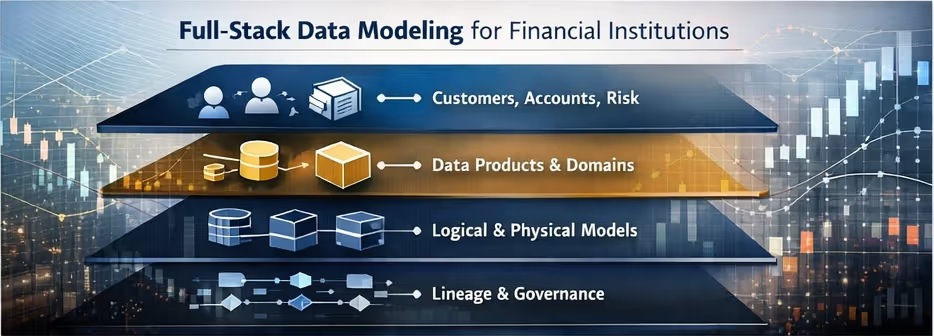
Full-stack data modeling connects data from business intent to technical reality.

It creates a shared, living model across:

  • Business concepts
    Customers, accounts, products, risk, exposure, policies, and transactions
  • Data domains and data products
    Owned, governed, and consumed across the organization
  • Logical and physical data models
    From conceptual design to schemas in production platforms
  • Lineage, ownership, and accountability
    Making it clear how data is defined, used, and governed

The result is end-to-end traceability from regulatory and business requirements to the data that powers reporting, analytics, and AI.

A Regulatory Capability — Not Just an Architecture Exercise

For financial institutions, full-stack data modeling is not optional infrastructure.
It is a regulatory control mechanism.

It enables organizations to:

  • Maintain consistent business definitions across regulatory, risk, and management reporting
  • Demonstrate clear lineage from reported figures back to source systems
  • Respond faster and more safely to regulatory change
  • Reduce dependency on undocumented knowledge and manual reconciliation
  • Strengthen internal controls and audit readiness

Instead of retroactively explaining data during audits, institutions gain the ability to prove trust by design.

Strategic Value for the Chief Data Officer

Strong regulatory foundations unlock strategic outcomes.

With full-stack data modeling, CDOs can:

  • Increase confidence in regulatory and executive reporting
  • Accelerate delivery of new financial products and regulatory updates
  • Reduce operational, compliance, and data quality risk
  • Enable AI and advanced analytics on trusted data foundations
  • Align data strategy, governance, and execution across the enterprise

In modern financial services, regulatory excellence and business agility are not trade-offs. They are mutually reinforcing.

How Ellie Enables Full-Stack Data Modeling

Ellie provides a shared platform for designing, governing, and evolving enterprise data—bringing business, data, and technology teams into alignment.

With Ellie, financial institutions can:

  • Create visual, shared data models that bridge business, risk, and engineering perspectives
  • Establish a data-as-a-product operating model with clear ownership and accountability
  • Embed governance, lineage, and standards directly into data design
  • Maintain a living system of record for enterprise data knowledge
  • Ensure data strategy is consistently reflected in production systems

Ellie helps organizations move away from static documentation toward active data governance that scales with change.

Financial Services Use Cases

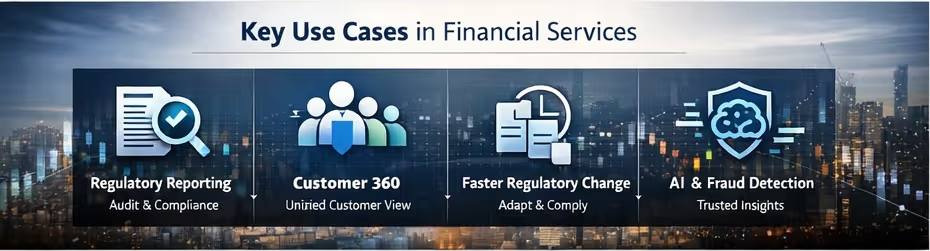
Regulatory Reporting & Risk Transparency
Trace reported metrics back to authoritative sources with clear lineage and definitions.

Customer and Counterparty Consistency
Align customer, account, and exposure definitions across business units and systems.

Faster Regulatory Change
Understand impact, implement changes, and demonstrate compliance with confidence.

AI, Fraud Detection & Advanced Analytics
Build explainable, trusted AI and analytics on well-defined data foundations.

Enterprise-Level Capability for Regulated Enterprises

Full-stack data modeling is no longer a niche modeling discipline.
It is a CDO-level, board-relevant capability that enables trust, control, and scalable innovation.

Ellie partners with financial institutions to establish data foundations that stand up to regulatory scrutiny—while enabling faster change, smarter decisions, and AI-driven growth.

Build data foundations you can trust. Design data products that scale. Govern data by design.