
You invested heavily in agentic AI, connected it to your data stack and gave it access to the systems it needs. The expectation was straightforward. Faster answers, more automation and less manual work. Instead, the answers still aren’t always correct. The agent may use the wrong definition of revenue, pull from the wrong source or miss an important relationship in the data, producing an answer that sounds reasonable but doesn’t match how the business actually operates.
It’s easy to label every incorrect answer a hallucination, but sometimes there’s a larger issue at play. The agent may have access to the right data without having enough business context to interpret that data correctly. Better prompts won’t resolve conflicting business definitions, and stricter workflows won’t help if the agent doesn’t understand how Customer, Account, Contract and Revenue relate to one another. Before investing in another layer of tooling, it’s worth asking whether your AI actually understands the business context behind the data it’s using.
This article looks at why AI agents produce inconsistent answers, how to tell the difference between hallucination and missing context, and how a semantic backbone can give agents a more reliable foundation to work from.
How to tell the difference from a hallucination and missing context
A hallucination happens when a model generates information that isn’t supported by the available data, tools or evidence. Missing context is different. The right information may exist, but the agent doesn’t have enough business context to know which interpretation is correct. Take a question like, “How much revenue did active customers generate last quarter?” The agent may be able to find the relevant data, but the answer still depends on several definitions. What counts as an active customer? Does revenue mean booked or recognized revenue? Does “last quarter” mean fiscal or calendar quarter?
There is also a third source of error. In multi-step agent workflows, the agent may choose the wrong tool, query the wrong source or carry a bad assumption into the next step. These failures require different fixes. Hallucinations call for stronger grounding and validation. Missing context calls for clearer definitions and relationships. Execution errors call for tighter workflow controls.
5 reasons AI agents give inconsistent answers:
Agentic AI introduces more autonomy, which also introduces more places for interpretation and error. Here are 5 reasons you may still be getting wrong answers:
AI can inspect tables, columns and schemas, but those structures do not always explain what a business term means. Customer, Revenue, Product, Claim or Account may have different definitions depending on the team or system using them. If the agent does not know which definition applies, it has to infer one.
Most organizations already have some of the context AI needs, but it often lives in different places. Definitions may sit in a glossary, relationships may live in data models, and ownership may be documented in a catalog. Business rules may exist in dashboards, governance tools or internal documentation. When that context is scattered, the agent has to reconstruct meaning from several sources, creating more room for error.
An agent may need to choose a tool, build a query, interpret the result and pass that result into another step. If it makes a wrong assumption early in the workflow, the mistake can carry forward. The more actions an agent takes, the more important it becomes to give it reliable context at each step.
Agents need rules around which systems they can use, which actions they can take and when approval is required. Without these boundaries, an agent may choose a path that appears reasonable but does not follow the organization’s intended process.
Even a well-designed agent will struggle if the data lacks enough context. Missing relationships, unclear metadata or undocumented business rules leave more room for interpretation. The agent may know what a field is called without knowing how it should be used.
Stop ambiguity from spreading through agent workflows
In traditional analytics, inconsistent definitions often show up when two dashboards disagree. Agentic AI can carry that inconsistency further. An agent may generate a query, summarize the result, pass it to another system or use it to trigger the next step in a workflow. If the original interpretation was wrong, this error can influence every action that follows. A vague definition of Customer is no longer only a reporting problem if an agent uses that definition to determine which accounts belong in an analysis or which records should be updated. As agents take on more work, shared business context becomes more important.
5 things AI agents need to work more reliably
Reliable agentic AI requires more than access to data and tools. Agents also need a clear understanding of the business context around that data.
Terms like Active Customer, Revenue or Priority Account should have agreed meanings that come from the business. AI can use those definitions, but it should not be responsible for creating them.
Agents also need to understand how concepts connect. Knowing what Customer means is useful, but the agent may also need to understand how Customer relates to Account, Contract, Product or Order.
Business definitions need to connect to the data that represents them. In practice this means linking business concepts to logical and physical models, tables, attributes and relationships.
Ownership, domain, status, synonyms and business rules can all affect how data should be interpreted. This context should be available alongside the model.
Semantic context is only part of reliable agentic AI. Agents also need clear permissions, tool boundaries, validation steps and confirmation rules.
How to reduce inconsistent AI answers
Organizations can reduce a large amount of avoidable ambiguity before an agent ever answers a question by:
Workflow controls reduce execution risk, while semantic context reduces the amount of business meaning the agent has to infer.
How to make shared business meaning reusable across your stack
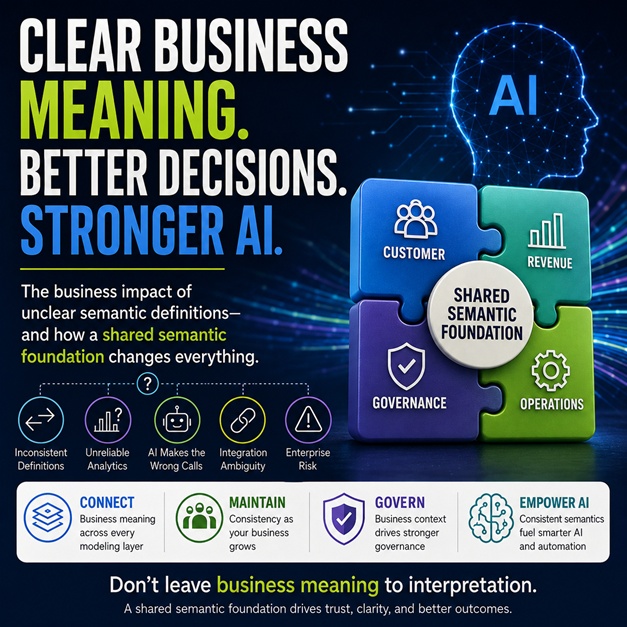
A semantic layer gives AI a shared understanding of what the business means. Instead of asking every agent to infer concepts like Customer, Revenue or Product from table and column names, those concepts can be defined once, connected to the data that represents them and reused across different workflows.
This context also needs to extend beyond a single agent or application. Most organizations use multiple tools across data and AI, from governance platforms and analytics tools to catalogs and AI agents. If each one maintains its own version of business meaning, the same inconsistency can reappear across the stack.
Ellie.ai is designed to act as the backbone for a universal semantic layer. Business and data teams can define concepts, relationships and models in Ellie, then make that context available to the systems that rely on it. Rather than replacing the rest of your stack, Ellie gives the tools you’re already using a shared semantic foundation to work from.
Use Ellie.ai to create context humans and AI can share
Ellie.ai gives teams a place to define business meaning in a way that can be understood by both people and AI. Conceptual models and glossaries help teams agree on core concepts and relationships first. Those concepts can then be connected to logical and physical models, so the business definition stays linked to the data that represents it.
Teams can also add context at the model, entity and attribute level, including ownership, domain information, business rules and synonyms. Metadata can be marked specifically as context for AI agents, giving them more than schema alone to work from.
The Lumi AI Assistant can use that same modeling context to explain models in plain language, trace relationships, identify gaps or inconsistencies and apply changes directly on the canvas. The result is a shared semantic foundation that people, analytics tools, governance systems and AI agents can work from without each one having to reconstruct the business independently.
What shared meaning makes possible for agentic AI:
Shared context doesn’t remove every source of AI error, but it reduces the amount of business meaning an agent has to guess.
Get more from your agentic AI investment with Ellie.ai
Organizations are already investing heavily in agentic AI, but access to more models, tools and data won’t fix inconsistent answers if the underlying business meaning is still unclear. When agents have to infer definitions, relationships and rules for themselves, even technically correct outputs can miss the way the business actually operates. A shared semantic backbone gives those agents a more reliable foundation.
With Ellie.ai, teams can define business meaning once, connect it to the data that represents it and make that context reusable across analytics, governance and AI workflows. Before investing in another layer of AI tooling, make sure the systems you already have are working from the same understanding of the business. Request a trial today.