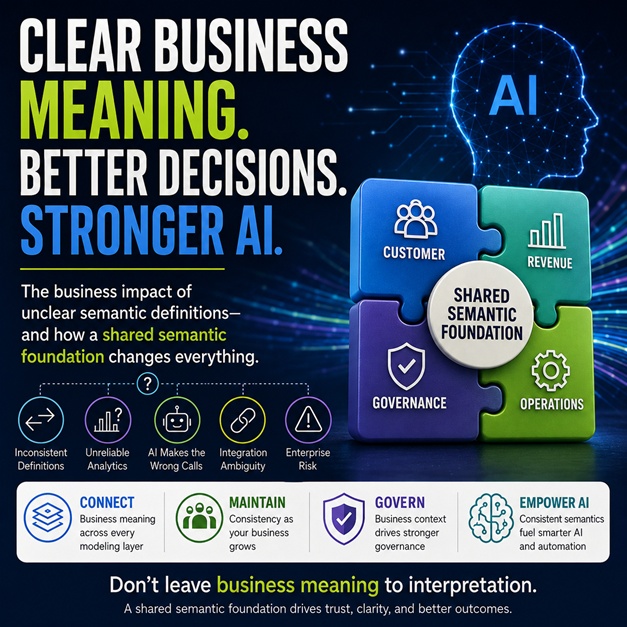

An AI agent can query a warehouse, inspect a schema and generate SQL, but that doesn't mean it understands the business behind the data. Ask, “What was profit from active customers last quarter?” and the answer depends on several definitions. What counts as an active customer? Does “last quarter” mean fiscal or calendar quarter? Does profit mean gross margin or net margin? The data may be available, but the business meaning still has to be defined.
As AI becomes more involved in analytics, governance and other data workflows, that context becomes essential. AI needs a consistent way to understand the concepts, relationships and definitions that shape how an organization uses its data. A semantic backbone provides that shared business context across people, systems and AI.
This article covers the importance of the semantic backbone, why fragmented context creates problems for AI and how organizations can make business meaning reusable across the wider data environment.
AI needs context, not just tables and columns
AI systems can inspect tables, columns, schemas and relationships, but that doesn’t tell them what the data means to the business. Take revenue for example. An organization may distinguish between booked, recognized and forecast revenue. An AI agent may be able to find all three, but it still needs to know which definition applies. Most organizations already have that context, but it’s usually scattered across glossaries, data models, catalogs, dashboards and internal documentation. When each tool or AI agent has to piece that meaning together for itself, inconsistent interpretations are more likely. A semantic backbone brings those definitions, relationships and supporting context together so they can be reused across the systems that need them.
Why a semantic backbone matters for AI
AI can only work reliably with enterprise data when it has enough context to interpret that data consistently. Without shared definitions and relationships, the same question can still produce different answers depending on which system, dataset or interpretation the AI uses. A semantic backbone helps by giving AI a shared reference point for the business.
This matters for three reasons:
What AI actually needs from a semantic backbone
A semantic backbone is more than a collection of definitions. It connects business meaning to the models, metadata and technical structures that represent it.
AI needs to know how the organization defines its core concepts. Terms like Customer or Revenue may sound universal, but their meaning is often specific to the business. Agreeing on those definitions gives AI something concrete to work from instead of relying on inference. Those definitions should come from the people who understand the business. AI can use that meaning, but it should not be responsible for deciding it.
Definitions alone aren’t enough, AI also needs to understand how concepts connect. A Customer may relate to an Account, Contract, Product or Order, and those relationships can affect how a question should be answered. Semantic models make those connections explicit instead of asking AI to infer them from table names or schema structure.
AI also needs a clear connection between business language and the underlying data. That means knowing not only what Customer means, but how that concept is represented in logical and physical models, tables, attributes and relationships.
Ellie.ai supports conceptual, logical and physical modeling in the same environment, helping teams connect business concepts to the technical structures that represent them. Conceptual glossary entities can also be linked to logical and physical entities so that business meaning stays connected to implementation.
Some of the context AI needs may not be obvious from the model structure. Ownership, domain, status, integration IDs, synonyms and business rules can all affect how data should be interpreted.
Ellie.ai allows metadata to be added at the model, entity and attribute level. Metadata fields can also be marked specifically as context for AI agents, making that information available alongside the model.
Why another isolated layer won’t solve the problem
Many organizations already have business context spread across analytics tools, catalogs, governance platforms and AI applications. If each system maintains its own definitions, the organization can still end up with several versions of the same business concept. A semantic backbone gives those systems a shared source of business meaning instead of asking each one to define it independently. This is where Ellie.ai fits. Business and data teams can define concepts, relationships and models in Ellie, then make that context available to the analytics, governance and AI tools that rely on it.
How Ellie.ai supports a semantic backbone for AI
Ellie.ai is designed to act as the backbone for a universal semantic layer. It gives teams a place to define business meaning, model relationships and create shared context that can be understood by both humans and AI.
Teams can use conceptual models and glossaries to define core business concepts, then connect those concepts to logical and physical implementations. Model, entity and attribute metadata can capture additional context such as ownership, business rules and domain information. This context can then support the rest of the data stack. Organizations may use tools like Saidot for AI governance, Collibra for data governance or Snowflake for query analysis, while Ellie provides the shared semantic foundation those systems can connect back to.
Instead of each tool maintaining its own interpretation of the business, they can work from the same models, glossary terms and relationships. This also helps bridge human and machine understanding, since business teams need context they can work with and AI systems need structured context they can consume. The Ellie.ai Lumi AI Assistant can also work directly with that context, explaining models in plain language, tracing relationships, identifying gaps or inconsistencies and applying changes on the canvas.
Why this matters
A shared semantic foundation can support more than one AI tool or workflow across the data stack.
Build the semantic backbone behind your AI strategy with Ellie.ai
A semantic backbone gives AI the shared context it needs to interpret business data consistently. With Ellie.ai, teams can define that meaning once and make it reusable across analytics, governance and AI tools. Request a trial today.