

Why Do Enterprise Data Products Fail So Often?
Because there's a growing gap between data and IT teams and business reality. Avoid failure with a platform that’s focused on collaboration between IT and Business when building data products.
Modeling Your Enterprise Data Platform
Working with Intangible Product Structures
An insurer or a telecom operator has to deal with intangible concepts. Like terms, renewals, coverage, bundles, etc.
While central to your operations, their meaning is not intuitively understood by all. This “intangibility” often results in:
Misaligned Definitions: Teams define & use terms inconsistently.
Disconnected Views: One unit might see a feature as a product, while another treats it as a configuration.
Complex Relationships: Customers often interact with the same product type across multiple channels, in different ways.

Gap Between Source Data & the Real World
Source data originates from operational systems.
Unfortunately, there remains a considerable gap between how data is structured in legacy systems like SAP or Oracle and how it should be organized in platforms like Snowflake or Databricks for analytics .
Taking this data as is and pushing it into a modern enterprise data platform does not free you from the baggage of enterprise systems.
This gap makes it particularly difficult for data teams to build efficient enterprise data products that are scalable.
Ellie connects source data and analytics products to enable faster deployment and greater quality within the final product.
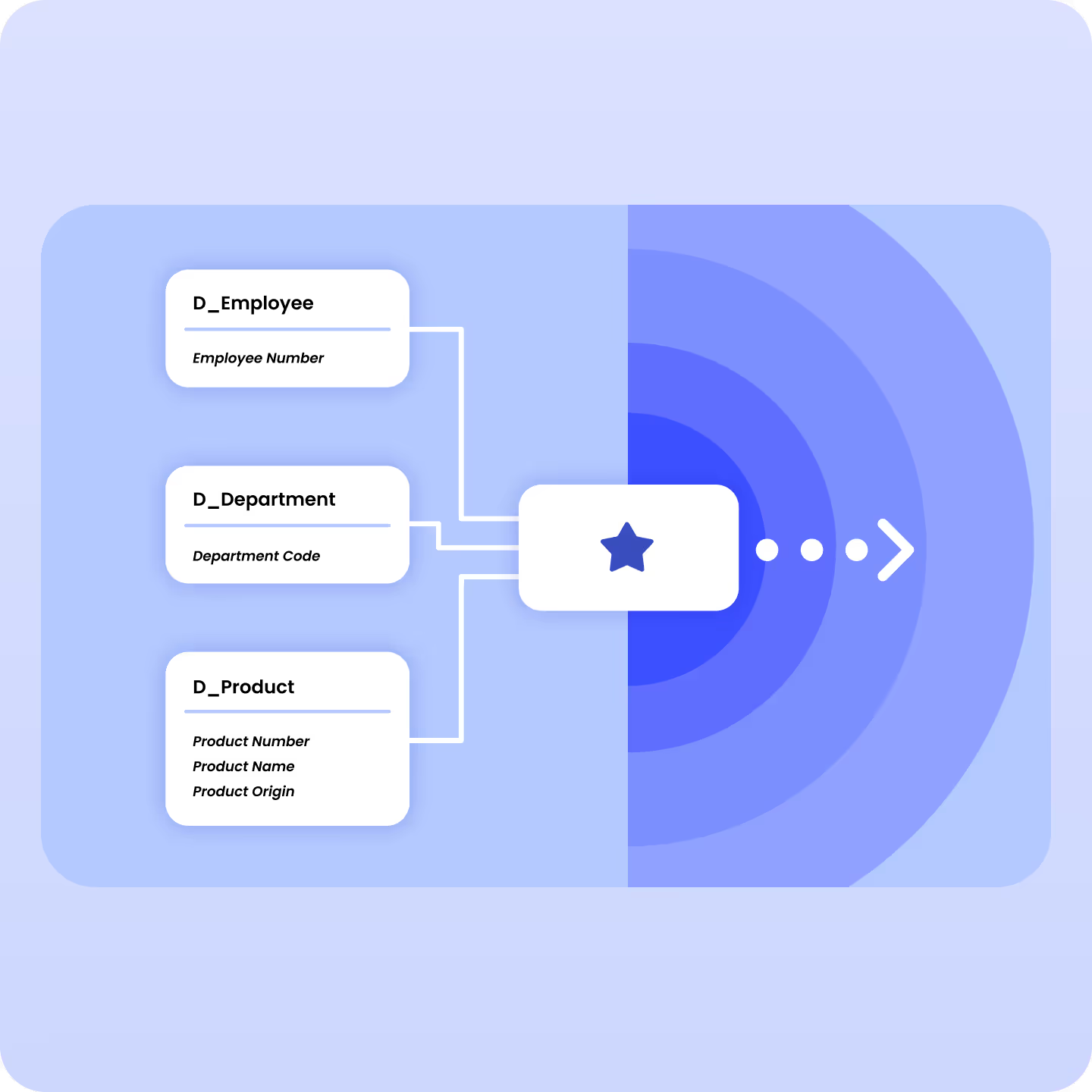
Reverse Engineering Legacy Systems
Complicated Customer Hierarchies
Customer relationships in service industries are intricate, with overlapping transactions.
For example, a single customer might represent a corporate subscription, a personal device plan, and the owner of a family plan all at the same time. Who should own the sales & marketing for this individual?
This makes it difficult to:
- Define a customer in the context of analytics.
- Link products and services to specific customer segments.
- Combine and analyze data across product segments.
Difficulty of Data Discovery in Legacy Systems
Reverse engineering legacy database structures doesn’t result in a data model that’s easy to understand.
From proprietary naming conventions to the use of third-party systems to extract data, documenting legacy data structures for a simple migration project can take days or weeks to complete.
It’s time that costs you directly because you’ve got consultants and engineers on the payroll trying to make sense of the source data.
Plus, understanding it once is not enough. It needs to be documented and the transformations tracked such that you get the support you need to build enterprise data platforms.
Complexity of Big & Wide Processes
Relying on International Standards for Scalability
One solution to these problems is the use of industry frameworks.
For instance TM Forum (telecom) or the International Organization for Standards (e.g. ISO20022 for financial institutions) has published standard business definitions and the connections between these entities to create a business or semantic layer.
However, these often break down when applied to real-world operational data. An enterprise data platform remains as complicated as without a framework if you cannot adapt these standards to your unique needs.
Natural Scale of an Enterprise Data Product
Scale does not refer to just the size of the company and the amount of data that the average enterprise data team has to work with.
In a large organization, even a simple data requirement could involve dozens of source systems and pipelines built using many platforms.
What’s missing is a central repository or source of truth.
One source of truth that captures the reality of database systems and business requirements.
One place where you can close the gap between these two such that data product implementation is a transparent, scalable process.

Designing for Different Business Contexts
Relying on International Standards for Scalability
One solution to these problems is the use of industry frameworks.
For instance TM Forum (telecom) or the International Organization for Standards (e.g. ISO20022 for financial institutions) has published standard business definitions and the connections between these entities to create a business or semantic layer.
However, these often break down when applied to real-world operational data. An enterprise data platform remains as complicated as without a framework if you cannot adapt these standards to your unique needs.
Complexity of Enterprise Domain Architecture
The average enterprise has dozens of domains that work on the same data from a slightly different perspective.
While your finance team might own the most important parts of the reporting, it’s not the only team that needs it. However, if you build all your data platforms to support financial reporting, you end up creating reports that do not provide value to the rest of the company.
Building out your enterprise domain architecture within Ellie enables you to capture a variety of business contexts.
Plus, these models are reusable and can be adjusted to meet specific data KPIs over time.
Why Ellie


Source Data to Enterprise Data Products Twice as Fast
Connect Data Sources & Make Sense of it with AI Assistance
- Reverse engineer source/legacy data warehouse
- Create conceptual/business entities and models from data (database structures)
- Import models from your technical modeling tools
- Customizable metadata to track data source (data lineage)
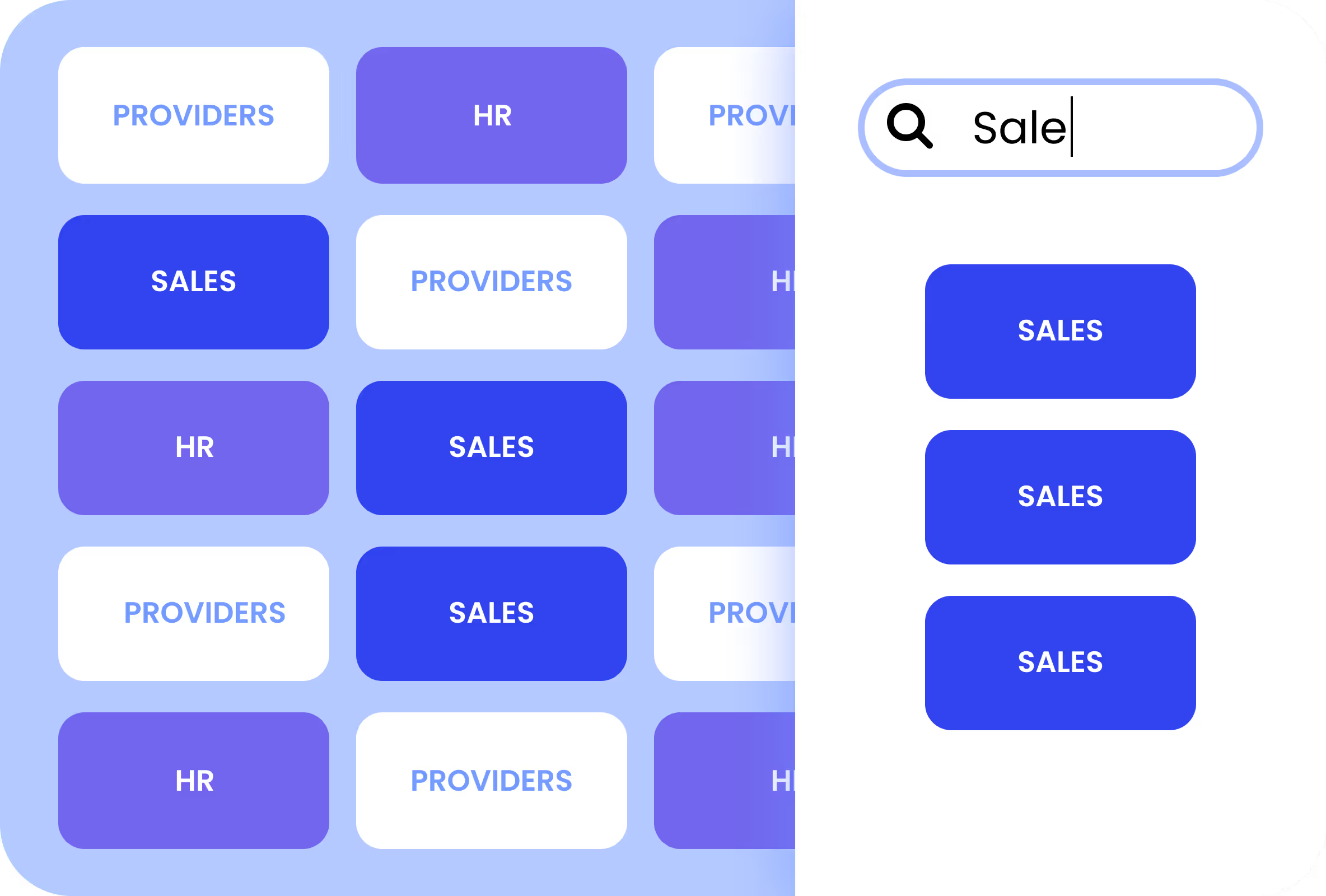
Organize Your Enterprise Data Model, Domain Connections
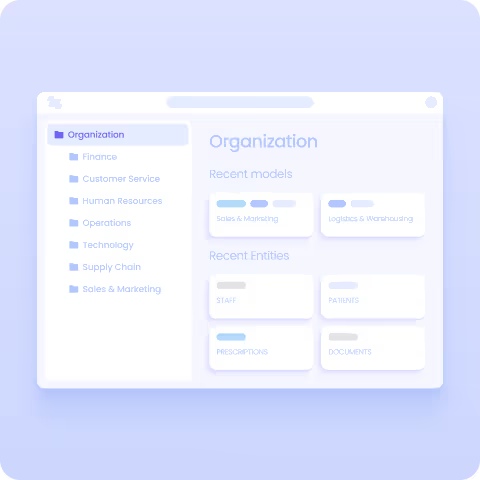
- Multi-level folder structures to isolate and contain what's imported
- Independent glossaries without conflict, which can be shared and updated
- Project-level "hub" with a standard glossary, with subfolders that have its own glossary when necessary
Collaborate on Data Models with Domain Experts
- Collaborate with business to define how data should be structured ('what should be')
- Build your semantic layer one domain at a time, gathering additional context every time
- Leverage AI agents to support data discovery and to close the gap between business & IT

Design Data Models to Build Your Enterprise Data Product
- Modernize for true transformation, because you have a firm grasp on 'what is' and 'what should be'
- Implement single use cases at a time without fear of creating conflicts, instead of waiting months or years to see results
- Create a foundation for incremental updates with model versioning
- Create reusable physical models/entities that represent reality
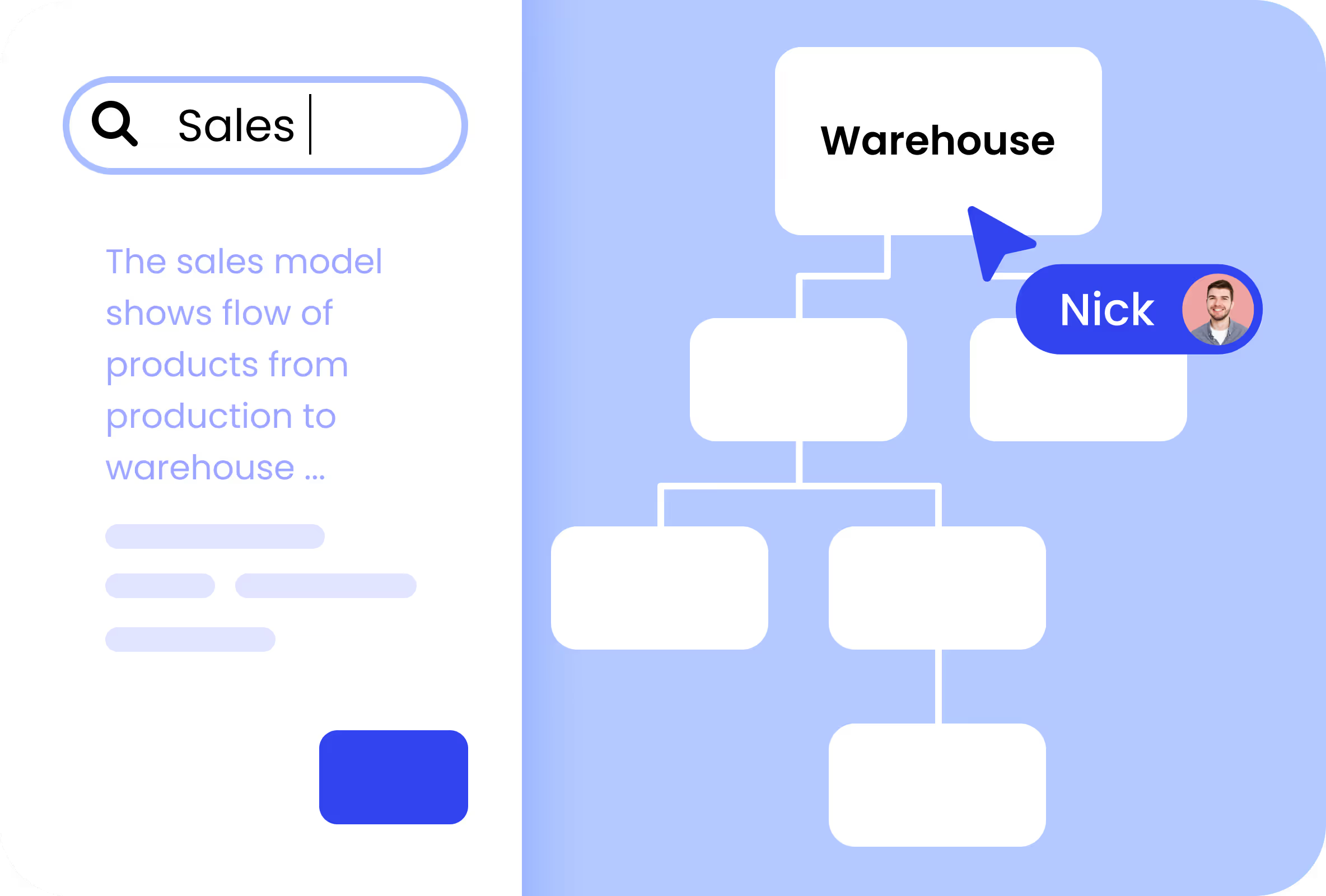
Maintain a Model (ER Diagram) of Your Data Warehouse


Get instant access to all the data that's present in your data warehouses through Ellie, and use it as a starting point for analytics KPIs
Discover Data, Decipher Your Data Warehouse with AI Assistance

Generate descriptions for your data (tables, columns), connect it to business entities, group it logically and connect multiple data sources
Transform Data Visually, Create Collaborative Analytics Projects
Use a no-code UI to complete simple data transformations, and share editable ER diagrams that represent your dbt models & projects
Integrate with Your dbt Projects, Generate & Push SQL & YAML Files
Benefit from workflows and folder structures that are compatible with dbt for easy integration and transition from Ellie to dbt
User Access Roles
Integrations & Open API Access


Plus, use our API to build connections with ease.

.svg)

%201.svg)
.svg)


